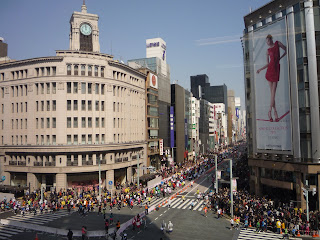
On Tuesday March 15th, 4 days after the earthquake, nothing had improved in Japan. As soon as one thing was resolved at the Fukushima power plant, another thing blew up (literally). With nuclear reactor after nuclear reactor failing, international media running rampant comparing the event to Chernobyl and calling it the worst nuclear disaster of all time, a lack of any up to date local information in English, and hysterical phone calls from parents, we decided to leave Japan. The decision was made around 11am, and after confirming with work that it was possible to leave and get a re-entry permit for my visa at the airport, we decided to book a (ridiculously overpriced) ticket to Korea, since my cousin Sam is living there. We bought the ticket at noon and our flight was at 4pm, so in a flurry of packing and hotel booking (our hotel in Seoul had a jacuzzi!) we were on our way to the airport.
The trains were not running at 100% and people at the airport had no idea about what I needed to do for my re-entry permit. We had a connection in Osaka, where we found out that we weren't booked in for the whole flight; just the domestic leg. Luckily, there were others in the same situation so they delayed the plane for us while we got our things sorted - but it was stressful to the last minute. Still, in a way we dodged a bullet. When we checked the news the next day; the line for re-entry permits at airports was massive, so we got out on the last day it was still seemingly normal to do so.
We arrived in Korea and made our way to our hotel. It was difficult to find from the metro station so we asked police for directions, and they gave us a ride to our hotel which was cool. Our first impression of Korea was that people were awesome, but overall we came to be disappointed with the trip.
Since we left in such a hurry I had no time to do my usual reserarch and trip planning, so we were at the mercy of a hotel tour to get a general sense of Seoul.
One of the first sights we saw as we were going to our tour meeting point... I'm convinced it actually took more work to load up the truck and get it stable like this, than it would to arrange it tetris style.
 The first stop was Changdeok Palace. It is one of the 5 great palaces built by the kings of the Joseon Dynasty, and because of its location east of Gyeongbok Palace (which we visited later in the week), it's also known as East palace. Completed in 1412, it's the second palace after Gyeongbok. The structures are wooden and beautifully painted in bright colors, mainly red and green. This is the main gate.
 The main palace for official business.
 The grounds of the palace were covered in noisy gravel, so someone sneaking around at night could be easily heard; assasinations were very common during this period. There are also no trees or anything someone could hide behind anywhere on the grounds.
 One of the official rooms, with surprisingly Western furniture.
 A good example of the beautiful paint job done accross the entire palace.
 Behind the small green door was the king's toilet, which the doctor had access to. He examined the king's poop daily to ensure he was healthy.
 The house was built on a furnace to heat the floors; quite advanced for the time.
 A walkway such as this one would connect the king's and queen's living quarters so the king could sneak around at night.
 The less ornate living quarters of more distant family, such as the queen's mother.
 After the palace we drove around Seoul, visiting various markets. This is a random side alley off the underwhelming art market.
 Namdaemun Market is one of Seouls most popular, and our guide took us to the jewelry hall where you can buy all sorts of costume jewelry for $1. The people sitting around are actually holding glueguns and making the jewelry that will one day be sold to claire's etc.
 Rice cake and crab meat on a stick; very common and delicious street food.
 After the tour we were dropped off in the busy downtown/nightlife area. Korea is well know for it's cheap cosmetics, and many Japanese come here just to shop. This street was lined with shops, each giving out free samples to lure you in. It worked.
 Same shopping street from a different angle. It was surprisingly clean and European, a contrast with a lot of the dirtier and smellier parts of the city.
 We ended up watching a comedy performance called Nanta. Apparently it was successful internationally, but originated here in Seoul. It was a good show; like Stomp but with food.
 Building 63 in Seoul, where we could get a bird's eye view of the city; everyone knows I like to get high when I travel. Where's Rick?
 Seoul was much bigger than I thought it was; it took getting high just to see how far it sprawled.
 The juxtaposition of old architecture juxtaposed with modern buildings is a common sight.
 The man in the throne invented the Korean alphabet. It looks like the alien language from V. In the distance you can see Gyeongbok Palace, and to the left of it a blue house. The blue house is the president's residence.
 Our second palace visit: Gyeongbok Palace.
 The throne room, with a painting of the sun and the moon over a hilly landscape behind the throne. The sun represents the king and the moon the queen. It's a very common image and appears above all thrones in the palace.
 A room for official business where the king can also relax as he works.
 The building where the Korean alphabet was invented.
 This palace was less colorful than the first, but still very nice. You can clearly see the noisy gravel that covered the grounds of the entire palace.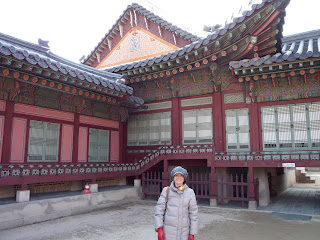


The round observation room in the left of this picture was my favorite structure in the entire palace.


A better picture of the painting: The sun is the king, the moon is the queen and the trees are the people.
 We spent most of the day at the Palace, since we were free from the tour we could explore every corner. From there we headed over to Itaewon, which was pretty much Little America. It's close to the US army base, so there are many foreigners and American franchises. It felt like the Annex.
In true Korean style, this Hard Rock Cafe is actually a random clothing store.

By coincidence, we found out that an old Amsterdam friend, Eveline, is now living in Seoul. We met up with her and her American boyfriend at a Korean BBQ place for dinner. It was delicious grilled meat (grilled at our table) with various toppings and sauces wrapped in lettuce leaves.

After a few days in Seoul we met up with my cousin in Pohang, the city where she works and lives. From there we caught a very long bus ride to Jindo for the sea parting festival. It was pretty much like any family festival in the world: festival food, old people singing, and everyone having a pretty generic time.
 Except the food was maggots...
 The sea parting was extremely lame. It was basically low tide; but since there is an island off shore it looked like a parting. The result was a gravel path leading from the main shore to the island, and lots of Koreans digging through the rocks for food (seaweed and sea creatures). I was not amused.
 But it was great to see Sam :)
 Since we took a cross-country bus to get to the festival, we slept in a town somewhere en route back to Pohang. It was a Saturday night and the streets were packed. We were also supposed to fly back to Japan on Monday, but since the situation remained unchanged, we decided to cancel our flight. This was done huddled outside cafes with free wifi, trying to skype with Rick's iPhone since the love hotel we were staying in didn't let us call long distance, and the phone card we bought was a total scam. In the end we were able to cancel our flight at no cost, which was great. This also meant that we had to spend more time in Korea (which we were getting tired of) or plan another escape.
 After the festival we parted ways with Sam and her friends and took a local bus to this small town. We were in the middle of Korea: in an area without international ATMs and where you can't use a credit card for anything. The whole time we were thinking: if we ever have to flee from the law, this is where we're coming back.
What's unusual about this town? It's actually not a real town. It's an abandoned set of a Korean TV drama.
 It was extremely detailed, and unlike the sets in Hollywood, where many are just 2D or trick houses, these were actually full streets with actual houses. The bakery even had fake bread in the windows.

 It was extremely detailed, and unlike the sets in Hollywood, where many are just 2D or trick houses, these were actually full streets with actual houses. The bakery even had fake bread in the windows.
We made our way through this hilly village...

From the top you can see that it's actually a set; the overpass on the left is a fake one to nowhere.


After our visit at the movie set, we made our way back to Pohang to meet up with Sam one last time. Unfortunately, the bus ride back was a nightmare. The woman at the station sold us a ticket for a bus that had already left, it took us forever to find an ATM in the town, and the guy sitting under the English "Tourist Information" sign spoke no English. With the exception of a few kind individuals, it was clear that the vast majority of Koreans had no desire to communicate with us and were annoyed by our very presence. Back in Pohang we stayed at the Hole In One, the worst hotel in the world.

Korean traditional clothes are nice; these dresses are similar to those worn by the performers at the festival. I think these are wedding dresses though...

I love how the gas stations are designed to fit into the traditional landscape.

Pohang is just a short bus ride from Gyeong-ju, the Kyoto of Korea. We wanted to do a tour but since nothing went our way in Korea, there were no tours available. We crammed our luggage into the world's most battered station locker and took a local bus to the Bulguksa Temple. It was a temple which still holds important spiritual significance, so it was nice to walk around the quiet grounds while people around us prayed.


Near Bulguksa was Seokguram Grotto, a giant granite Buddha carved into a hill. This was by far the coolest part of Korea.
Exterior:

Interior - no pictures allowed but I took one anyway.

That day we took the bullet train back to Seoul and checked into our hotel. We were surprised to see a fruit market on a metro car at the subway station near our hotel.
 We wanted to do a tour of the Joint Security Area with North Korea, but since Korea hates us, it was closed. Instead we did a tour of the Demilitarized Zone (DMZ), which was pretty interesting. When we arrived at the DMZ Rick had an instant fan club. It's nice traveling to a foreign country where the local men don't harass me for once.
 First we visited the attack tunnels that were dug by North Korea to invade South Korea. There were many tunnels, some reaching as far as Seoul, but they were uncovered when one of the North Korean tunnel engineers defected to South Korea with information about their locations. North Korea went as far as painting the tunnel walls black so that they could claim they were coal tunnels.
That's not the wackiest thing North Korea did though... This is a picture of North Korea. No pictures allowed but I took one anyway, of course. If you zoom in you can see two flagpoles at the border; one with South Korea's flag and one with North Korea's. The North Korean one is much taller; it's in fact that tallest flagpole in the world as measured by Guiness. South Korea let the North have this one. The apartment buildings visible in the background are also fake, movie set type buildings to give the illusion of economic vitality in North Korea.

In the hopes of reunification, South Korea built a train station in the DMZ that will one day link the two country's railway systems.
 There was even a manned tourist information desk at the station. However, our guide said that reunification seems unlikely at this point. The two country's are nowhere near any reconciliation, and the generation that still remembers a unified Korea is dying out. As a result, the people who remain are those who have always lived in a divided Korea full of hostility towards the other side.
All in all we saw alot in Korea and somehow managed to have a good time, despite some of the awful individuals we encountered along the way. The stressful reason for our visit, the lack of planning and astronomical last minute costs also contributed to us terming it "our least favorite place to visit". Since we were still not able to return to Japan though, we decided to move on to a different country...